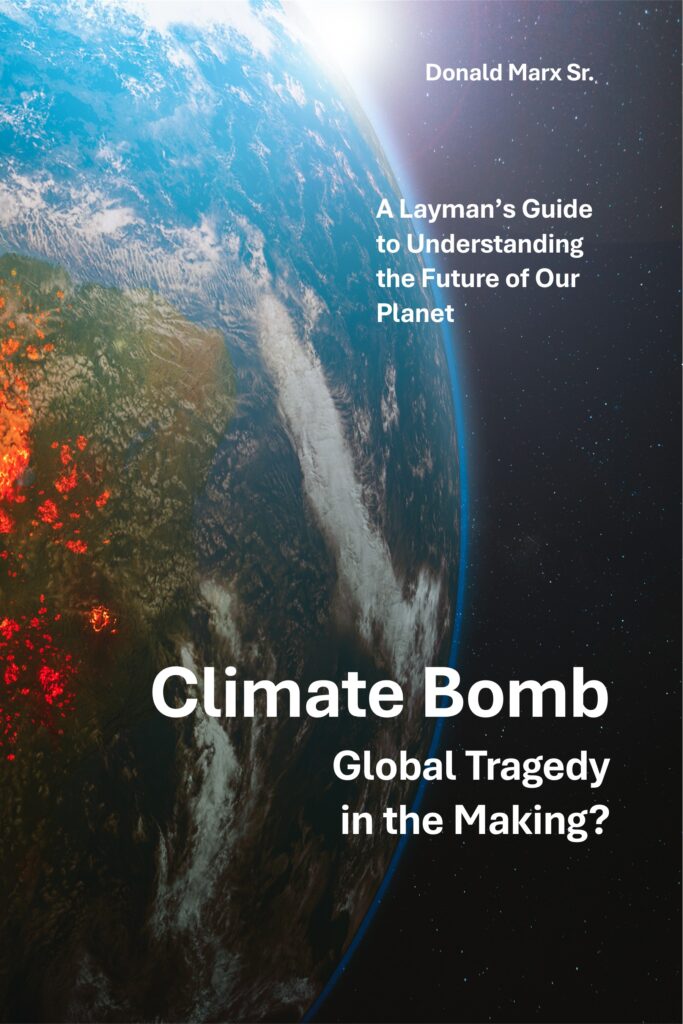
Description
Climate Bomb – A Global Tragedy in the Making is a layman’s guide to understanding climate change – the science, the politics, the unkept promises, the greed, the sabotage, and the lies that are leading to climate catastrophes later in this century. Donald Marx explains that humanity has already exceeded the United Nations emissions targets intended to prevent catastrophic climate change, with little regard for avoiding irreversible damage. “The climate is changing, and as our understanding of global climate change evolves, the more dire the picture for our planet becomes.” Marx anticipates the foreboding impacts of climate change in an exceptional way and predicts what the year 2100 holds for humanity on the present course.
Marx, a scientist-engineer and technology planner with over 65 years of on-the-ground experience in aerospace and technology, argues that humanity is driving toward a cliff at high speed, seemingly oblivious to the impending catastrophe. He debunks pseudo-science offered by climate deniers and attacks the myth that climate change is a hoax. He addresses dozens of difficult questions that most climate observers avoid, squarely pointing to the role of money and power in stymying progress toward solutions and to the failing global leadership strategies. Marx argues that humanity has never collectively faced a crisis of this magnitude in the history of civilization, and that World Wars and pandemics pale in comparison.
This forward-looking book goes beyond current literature to address the complex interactions among science, politics, and social structures, and their impact on humanity’s response to the impending climate crisis, and asks whether, ultimately, humanity will have the collective will, intelligence, political stability, and spirit of sacrifice to save the planet from catastrophe.
His description of climate science is broad, as he looks to where science is headed and to China’s lead in climate mitigation and adaptation, while the US supports expanding the use of fossil fuels for economic development. Marx lauds the UN’s historical role in addressing climate change, which led to the Paris Agreement in 2015, but believes the leadership model that gives every nation veto power over solutions is now stalled and that a new model of enthusiastic, willing nations should be the leadership strategy for the future.
He faults global leaders for not moving climate change from a movement, a collection of ideas, technologies, and investments, to a more engineering-based, comprehensive system of systems approach. He asks. “Where are the feasibility studies, the tradeoff analyses, the cost-benefit analyses supporting climate response options?” He offers a systems engineering model to guide future technologies, along with a suggested roadmap. His views point to a new way of thinking about how to manage the global response to climate change, and how artificial intelligence will contribute. The book is encyclopedic in format, with more than 60 short chapters that make understanding easy. If you read only one book on climate change in your lifetime, it should be this book.