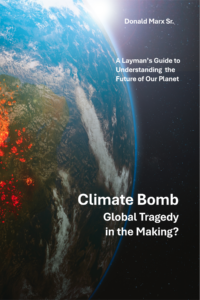
Global Tragedy in the Making
A Layman’s Guide to Understanding the Future of Our Planet
Climate Bomb the Book –
An update to climate science, current warming trends, global leadership, disinformation, and a look at the year 2100 on our present course
“If you read only one book on climate change, this should be it “…. James D.
“A frightening evidence-based forecast of where our planet might be headed” … William C.
Climate Bomb is where you can learn more about climate change and its impact on Mankind.
“Learn about climate change for the sake of humanity.”
I wish to provide feedback on the book, blog, or website.
Join Friends of Climate Bomb to receive updates and important
news from this site. Absolutely private with NO dissemination and NO marketing.
Notable Quotes from the Book
Why should we care about CO2?
“Atmospheric concentrations of CO2 have increased 40% since the invention of the automobile, exceeding any natural concentration in the last 800,000 years, but climate deniers claim there are no consequences. At the same time, humanity has destroyed 2.7 billion acres of forest since 1900, one of nature’s most effective tools for controlling CO2 concentrations. Denial is poisonous.”
Why do nations and industry deny climate change?
“The adoption of green energy technologies could cripple the economies of oil-producing countries, including the United States, Saudi Arabia, Russia, Canada, China, Iraq, the United Arab Emirates, Brazil, Iran, and Kuwait. Yet untapped fossil fuels represent tens, perhaps hundreds of trillions of dollars in future profits over the century, which oil and gas interests will fight to protect at any cost. They are profoundly incentivized to deny the causes and effects of climate change for as long as they can get away with it. In the United States, the oil lobby, with billions of dollars to spend opposing climate change initiatives, has successfully turned the U.S. government against green technologies and terminated climate research to forestall erosion of oil and gas profits – at the risk of enormous global economic losses later in this century,”
Why do we believe in science vs. politics?
“In four thousand years of history, humanity has thrived through science yet often failed miserably in its political and ideological endeavors, as evidenced by its inability to overcome armed conflict, achieve peace, and address global poverty and hunger. Do not be misled by political or ideological arguments.”
“The scientific reality of climate change is irrefutable, although the magnitude of warming and the timing of catastrophic changes cannot be accurately predicted with current knowledge. That does not mean that we cannot foresee events sufficiently to cause alarm. Climate science is advancing rapidly. The problem is that humanity is entering an era that science has never addressed. On the other hand, mankind’s response to climate change is far more uncertain. The climate change response is far too complex to debate through political talking points or on social media. It involves mankind’s deepest drives for near-term gain without sacrifice – “what’s in it for me.”
“In perspective, for forty millennia, humanity has not been able to agree on how to solve relatively simple problems such as global hunger and poverty, and on sustaining peace. Successfully fighting the coming effects of climate change, collectively infinitely more difficult than anything humanity has ever faced, seems improbable.”
“Mankind is driving toward a cliff at high speed, seemingly oblivious to the coming catastrophe. The cliff is not yet in view, but the warning signs have been many.”
Will climate change bring an end to our planet?
“On the present path, mankind may push the limits of its ability to adapt while maintaining the quality of life we have come to expect. That doesn’t mean mankind will wither away. Instead, life will become far more difficult; where you live today may become uninhabitable for your great-grandchildren; weather extremes may ravage the planet; and the Earth may not be able to sustain agricultural production to meet the needs of growing population levels. In any case, everything will become extremely expensive, and some things, like homeownership and property insurance, may be unavailable to most.”
“Mankind has never collectively faced a crisis of this magnitude in the history of civilization as we know it. World Wars and pandemics pale in comparison. Nothing in human history suggests mankind is up to the task. Led by self-serving politicians, science and climate deniers, Wall Street profiteers, and doomsday religious ideology, our world seems unwilling to deal with the crisis that may well alter life as we know it. Ignorance and apathy abound while the planet suffers.”
Are we making enough progress in climate response?
“While current efforts to mitigate climate change are to be applauded, they fall far short of achieving meaningful global changes. At the same time, fossil fuel proponents are pushing production ever upward in the name of the economy, national security, and profit.”
“Much of humanity remains on course for a much warmer planet with abandon. Currently, we have not done enough to reduce peak global warming, and even less to prepare the world for a much hotter planet.”
“Today, with oil, gas, and coal-producing nations and their industry counterparts working together to increase fossil fuel use over the coming decades, global net-zero may be only a dream this century.”
“The past decade has witnessed continued growth in greenhouse gas emissions, rendering promised climate change responses largely ineffective. The world sorely needs a different framework for climate action that realistically addresses climate risks and provides a path toward a globally strategic plan. Existing frameworks have failed to achieve results consistent with goals and seem unlikely to offer meaningful actions – despite their assertions to the contrary.”
“The goals of the Paris Agreement remain aspirational and unattainable within the timeframe envisioned by the signatories. Accelerating global temperatures and CO2 concentrations indicate the goals set in 2015 are now likely insufficient to halt global warming in this century without extraordinary climate response actions. Suggestions that the climate change response will be accelerated appear overly optimistic given the extensive political and social hurdles discussed in this book.”
“Humanity has already exceeded emissions targets intended to prevent catastrophic climate change, with little consideration for preventing irreversible damage. The climate is changing. The window to avoid devastating climate change is closing. Concentrations of planet-warming carbon pollution in the air are at their highest level in more than 2 million years – and the world has yet even to hit peak fossil fuel emissions.”
“In four thousand years, humanity has not been able to agree on how to solve relatively simple problems such as global starvation, poverty, and the maintenance of world peace. Successfully fighting the coming effects of climate change, collectively infinitely more difficult than anything mankind has ever faced, seems improbable on our present course.”
“The world is not prepared for the magnitude of economic losses that will accrue from climate change.”
“Consider that humans emit 40-45 billion metric tons of greenhouse gases into the atmosphere each year, 1.5 trillion metric tons of CO2 over the past 100 years, yet the deniers say these emissions have had no impact on atmospheric CO2 concentrations. There are 1.5 billion vehicles on our planet, 8000-9000 fossil fuel power plants, 85,000 – 110,000 commercial and military aircraft, and nearly 400,000 general aviation aircraft, all emitting greenhouse gases; yet climate deniers tell us to believe, without proof, that these fossil fuel-burning machines are not affecting greenhouse gas concentrations in the atmosphere.”
“Despite past global leadership achievements, climate change leadership is stalled or in decline, constrained by the opposing forces of fossil fuel interests, scientific evidence, and the public good. The world desperately needs new leaders and leadership strategies with a common goal, even if that does not achieve consensus.”
“The question Americans must ask: ‘Why is climate response so important to China and not to America?” Are we sacrificing our future to satisfy the near-term greed of the wealthy? Are we ceding global leadership to other nations to serve the few who benefit from inaction? Or are we just ignorant by choice?”
“These projections indicate that humanity may be on a path of rising CO2 concentrations for centuries unless it takes aggressive action, which is not foreseeable in the near term due to political hurdles, national and corporate economic pressures, and lack of public pressure.”
“Climate change response requires more than a citizens’ movement, scientific data, technological ideas, and funding and investment. Climate change response will ultimately be a very complex system of systems, and it is crying out for systems-of-systems, low-level system analysis and planning – something systems engineers do – and something that is barely being considered in today’s leadership strategies.”
Fossil fuel is a bad long-term business.
“Investing in climate technologies accelerates decarbonization, enhances resilience, and creates economic opportunities in emerging green industries. Total investment over the next 10 years is estimated at $28 trillion, compared with the fossil fuels industry’s investment forecast of $4.5- $6.0 trillion. Investing in climate response is a far more lucrative long-term business than investing in fossil fuels.
“As the planet continues to warm, extreme weather events will become more frequent and severe, necessitating substantial capital for humanitarian aid, disaster recovery, and community rebuilding. As these needs increase, capital for longer-term climate change response may diminish precisely when it is most needed to reduce the magnitude of further disasters. Immediate disasters might bankrupt the very activities necessary to reduce the risk of massive future disasters.”
“The climate change response must graduate from a movement to a more sophisticated global endeavor undertaken by the willing and enthusiastic, unhampered by the unwilling, obstructionists, and saboteurs.”
“In the fickle world of national and international politics, few facts endure over the long term. Instead, mostly incomplete or false ideas prevail, driven by ideologies that focus on fear and emotional reaction. Unfortunately, climate response is currently driven by politics that center on financial interests, perceived grievances, and fear.”
“Accountability will come, just as the untruths that effectively destroyed the United States tobacco industry did; economics will eventually prevail on a much larger scale. Many years from now, when the trillions in oil profits are less valuable than the trillions in economic destruction caused by climate change, and mankind bears the brunt of these financial losses, accountability will come. Citizens will demand that the oil producers make reparations for their economic losses.”